Chicago Fire
Insurance Patrol






Patrols 1 & 2 located at 100 S. Desplaines Street
Photo Courtesy Ken Little
Patrols 3 & 4 located at 5004 S. Union Avenue
Photo Courtesy Ken Little
Patrol 5 located at 1044 N. Orleans Street
Photo Courtesy Ken Little
Patrol 7 located at 3107 W. Fullerton Ave
Photo Courtesy Ken Little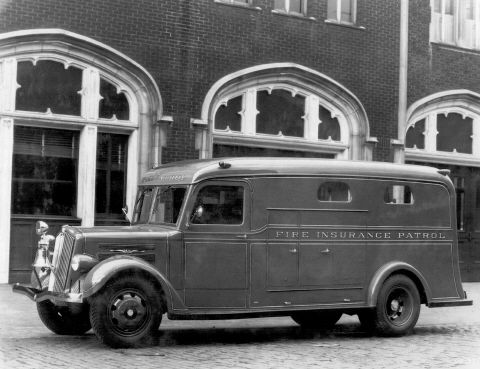
Chicago Fire Insurance Patrol
1937 White in front of Patrols 1&2
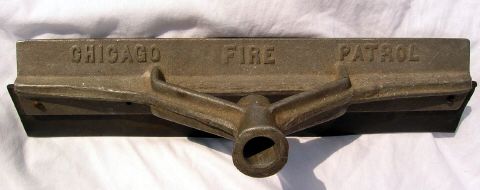
(squeegee)
The Chicago Fire Patrol was the only Patrol to design its own squeegee.
Patrol Lieutenant Peebles is credited with its unique design.

1928 photo showing Patrol 5 in front of their quarters
at 1044 N. Orleans Street.
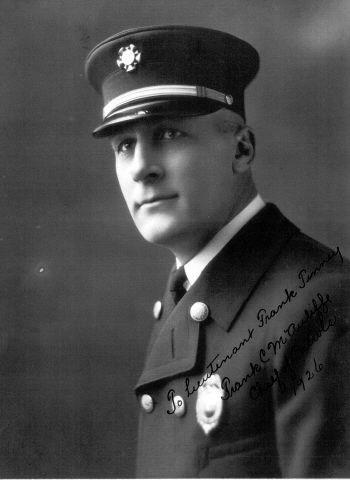
Chief Frank McAuliffe’s seven passenger Imperial Cadillac
purchased on November 25, 1926 for $4000.

Chicago Fire Insurance Patrol
(Helmet Front)

Chicago Fire Insurance
(Lieutenant's Helmet)

Fire Fighter Fatality Investigation and Prevention Program
USFA Firefighter Fatalities
Firefighter Casualties 1996-2005
SO YOU WANT TO BE A FIREFIGHTER???


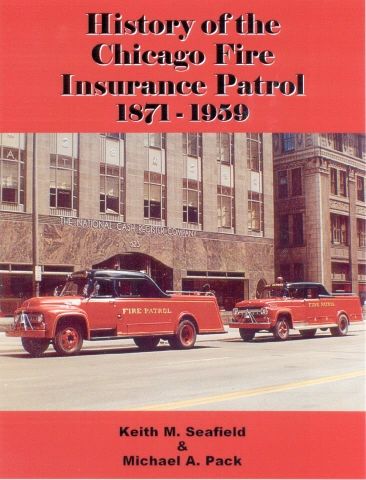
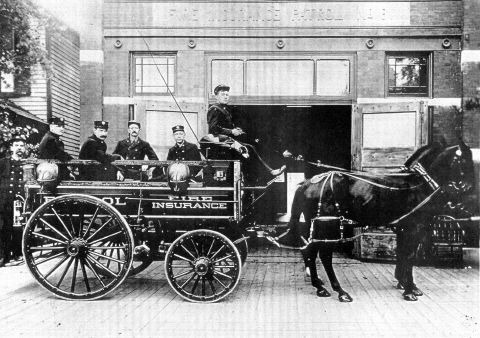 The first fire-alarm boxes were installed in 1865. The most destructive fire that Chicago had yet experienced occurred October 19, 1857. Twenty-three lives were lost and property damage was extensive. As a result of this fire, the Citizens Fire Brigade of Chicago was formed on November 19, 1857. Consisting of businessmen and insurance companies, the duties of the brigade were to take valuable goods from burning buildings and prevent damage by water and thievery. The Chicago Fire Insurance Patrol, organized October 2, 1871, had its beginning in this Citizen's Fire Brigade. The great fire of 1871 (October 8) led to a reorganization of the
  Fire Department on a military basis. The city was divided into 18 battalion districts, the companies in each comprising a battalion, under the charge of an Assistant Fire Marshal or Battalion Chief. The fire department stopped using horses for fire trucks February 5, 1923, with Fire Engine 11, at 10 East Austin Avenue. Fire alarm box 846 at State and Chicago Avenue was pulled at 12:40 p.m. and with the horses scrubbed and groomed, the old steamer rolled out of the swinging doors for the last time. While they were gone the new motor apparatus was backed into place, and the motorization of the Chicago Fire
 Department was an accomplished fact. The drivers took a cheer from the crowd on the return to the firehouse and then the horses were taken to the House of Correction to be sold. An important date in the more recent
 history of the Fire Department is January 1, 1958, when the Bureau of Fire Investigation was created. Prior to its inception, the sources of many of Chicago's fires went undetermined. Knowledge of the causes of fires has proved to be extremely valuable not only in the prevention of potential fire, but in aiding insurance companies in their investigations and increasing the protection of the citizens of Chicago. All of the personnel assigned to this unit have completed arson courses at various universities throughout the country and are thoroughly trained in their respective fields. Another recent milestone in Chicago Fire Department history was the construction of the Fire Academy, a $2.5 million Fire Department complex with the most modern training school in the country.
Built on the site of the famous O'Leary home where the great Chicago Fire of 1871 started, the Fire Academy was dedicated in May, 1961. Today the 4,314 firefighters and 619 paramedics of the Fire Department rank among the world's best.
A Chronological History of Chicago: 1673- Compiled by Chicago Municipal Reference Library, City of Chicago Updated by Municipal Reference Collection, Chicago Public Library Last Updated: 08/1997
The History of the Chicago Fire Insurance Patrol is
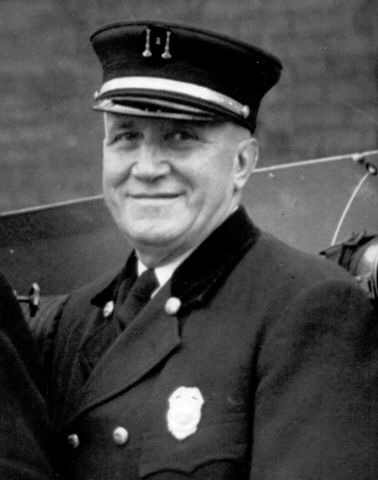
dedicated to the memory of my grandfather
Captain Michael Kinsch.
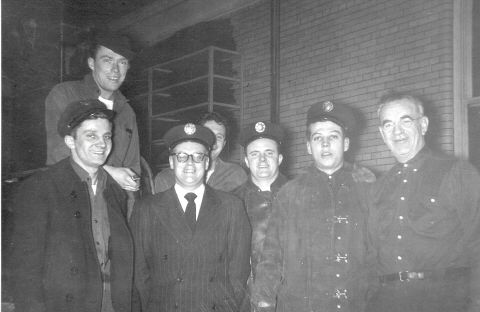
Top row L-R Warren Redick, Jim Hastings and Loren O’Rourke
Our deepest condolences to the families of Earl Nootbaar and Bill Schneidwind who passed on a few months ago.
Excerpts from the chapter:
“In Their Own Words …. The Men of the Patrol.”
Patrolman Don Kelso: “We had a fire at a mattress company and the building had chutes in there for the mattresses. We were below the fire placing covers, when all of a sudden some mattresses on fire started sailing down the chutes and chased us right out of the building. We didn’t expect this and the whole place ended up burning down".
Patrolman Earl Nootbaar(Passed away 2006): “I was 23 years old when I went on the Patrols and even now at age 80, I can still remember the Patrol slogan – “Mid summer rains and winter snows, thru portals these which never close, speed loyal hearts and willing arms, duty bound to fire alarms.”
Patrolman Pierce Buckley: “When I came on there was a handball court in Patrols 1 & 2’s house. For training they brought you in there and you simulated covering racks of clothing and racks against the wall. Racks against the wall had to be covered by getting something to weigh down the covers at the top because you couldn’t get behind them. We also simulated making chutes and how to properly cover an open roof to prevent further damage. They placed you with an experienced patrolman and you practiced throwing covers everyday and after while it became second nature to you.”
Patrolman Tom Flavhive: “I remember another call. It was 7 o’clock at night when we got a run and as we turned on to Madison Street, we noticed the fire was blowing halfway across the street. Just as we were coming to a halt in front of the building, a man came out of the top floor without a stitch of clothing and landed on the sidewalk right next to the rig. When he hit the sidewalk he just splattered all over. Needless to say, I had never seen anything like that before. While we were working inside the building, some Good Samaritan picked up this poor soul and placed him in our rig. We took the man out of our rig and boy there was a real mess in there. So when we got back to quarters, I as the candidate- the new kid on the block, it was my job to clean out the inside of the rig.”
Patrolman Warren Redick:“I was detailed to Patrol # 7 and while there we responded on a water flow alarm to a paint manufacturing plant on Fullerton Avenue, just west of Pulaski. Upon arrival we found fire in a paint drying room on the 2nd floor with extensive interior communication due to the overpowering of the sprinklers by flammable liquids and vapors – the end result being a 2-11 alarm and a large loss to both building and contents. An immediate fire department response would have certainty made a great difference, to say the least. The sprinklers did their initial job, but were overpowered as indicated.” 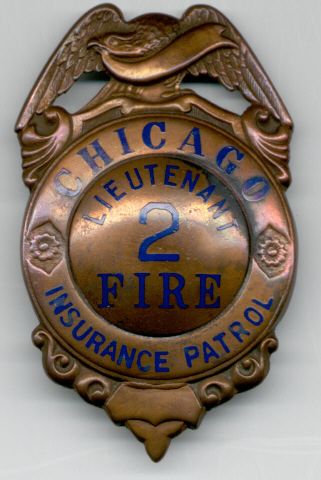
Chicago Fire Insurance Patrol
(Lieutenant's Badge)


